



Last reviewed September 2026
A newborn needs one thing from a pram that an older baby does not: to lie flat. Their airway is not yet strong enough to sit semi-reclined for long, and their spine is still curled from the womb. Every decision about a newborn pram comes back to that, and there are three ways to get it: a bassinet, a seat that reclines fully, or a capsule for short stretches. Here is how they differ, which prams offer which, and when the newborn stage ends.
The rule: Flat for walks and naps; a capsule only for the car and short trips
Bassinet: A bed on wheels. Best for long walks and for lifting a sleeping baby off
Lie-flat seat: Simpler, lighter, and it lasts until the toddler years
Switch to the seat: When they sit unassisted or start pushing up, usually around six months
The three ways a newborn rides
| Bassinet | Lie-flat seat | Capsule | |
|---|---|---|---|
| Position | Fully flat, enclosed | Fully flat, in a harness | Semi-reclined, in a harness |
| Best for | Walks, naps, the first six months | Everyday use from birth to toddler | The car, and the trip from car to shop |
| Time limit | None for daytime | None | Keep it short, with breaks |
| Faces you | Always | On a reversible seat | Always |
| Lift off asleep | Yes | No | Yes |
Bassinet: the case for and against
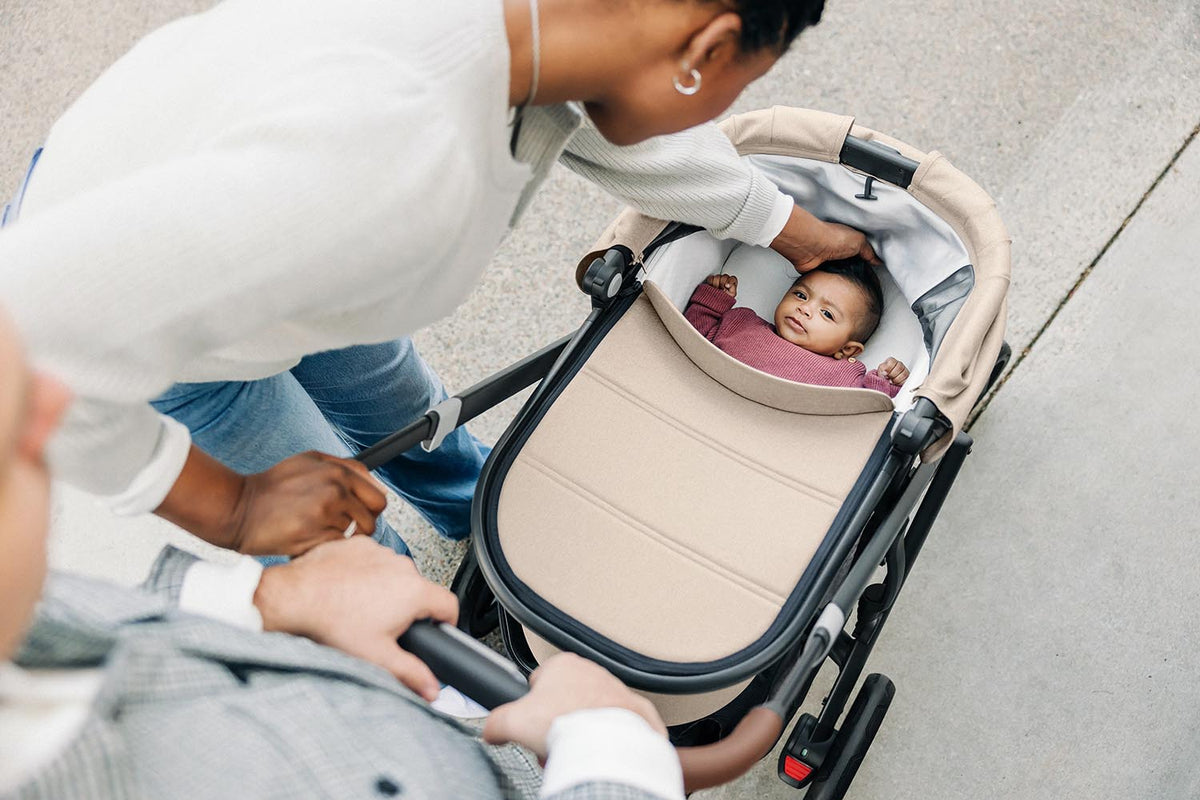
A bassinet is a proper flat bed. The baby lies in it without a harness, with the sides around them, and you can lift the whole thing off the frame with the baby asleep inside and carry it indoors. On a long walk it is the most comfortable place a newborn can be. You also see the baby's face the whole time, which for the first few weeks is most of the point of the walk.
Against: it is one more thing, it is done at around six months, and it takes a second position on the frame. On a Vista V3 none of that matters because the bassinet is included in the box and the frame was designed to carry it. On a Cruz V3, Kona or Minu V3 the seat lies flat from birth as sold, so a bassinet is an optional extra rather than a need. See the bassinets.
Lie-flat seat: simpler than it sounds
A seat that reclines fully, with an infant insert to support a small body, is suitable from birth. The baby is harnessed, which some parents prefer, and there is nothing to swap out at six months: the recline simply comes up as they grow. The Minu V3, Cruz V3 and Kona all ship this way, insert included.
The one thing to check is that the recline is genuinely flat and the manufacturer says from birth. A deep recline is not the same thing, and "from birth with a bassinet" means the seat alone is not.
Capsule: for the car, not the walk
A capsule holds a baby semi-reclined, which is exactly right in a moving car and acceptable for the ten minutes between the car park and the cafe. It is not a place for a long walk or a long nap. The rule most paediatric advice settles on is to keep capsule time short and give the baby a break lying flat on longer trips.
Used for what it is for, a capsule on the pram is the best thing about the first year: the baby sleeps through the drive, the car park and the shops without being unbuckled once. The Mesa clicks straight onto a Vista or Cruz and onto the others with adapters. Our travel system guide covers the combinations.
When to move from bassinet to seat
Not by the calendar. Move to the seat when the baby can sit up unassisted, or when they start rolling, pushing up or trying to pull themselves up in the bassinet, whichever comes first. A bassinet has no harness, so the moment they can move on their own it is no longer the right place. For most babies that is around six months; for some it is five, for some seven.
The reverse question, when to stop using the bassinet, has the same answer. If they fit and cannot yet move, it is still fine. If they can move, it is done, however much room is left.
When you make the switch, the toddler seat starts in its most reclined position and facing you. Over the next few months the recline comes up and, when they would rather watch the world than watch you, the seat turns around.
Safe sleeping in a pram, in plain terms
- Flat, on a firm surface, for naps. A bassinet or a seat reclined fully.
- Nothing over the face. Use the canopy and the bug shield for shade, never a blanket or a wrap draped over the pram, which traps heat and blocks air.
- Watch the temperature. Prams warm up fast in an Australian summer; a pram fan and shade help, a covered pram does not.
- Harness in the seat, always, even reclined flat.
- Bassinet on the frame or a proper stand, never on a bed or sofa, and not for overnight sleep.
Which UPPAbaby for a newborn?
- The complete answer: Vista V3. Bassinet in the box, reversible seat, takes a Mesa directly, and later takes a sibling.
- One child, everyday: Cruz V3. Lie-flat from birth, bassinet optional, Mesa direct.
- Small space, city: Kona. Lie-flat from birth, reversible seat, 53.3 cm wide.
- Lightest: Minu V3. Lie-flat from birth, 7.6 kg, forward-facing only.
Questions parents ask
When do you change a pram from bassinet to seat?
When the baby can sit up unassisted, or starts trying to roll or push up in the bassinet, whichever comes first. For most babies that is around six months. The bassinet is not a weight limit so much as a developmental one: once they can move, they need a harness.
Can a baby sleep in a pram bassinet?
For naps on the move, yes: a pram bassinet is flat, ventilated and designed for exactly that. It is not designed for overnight sleep. Keep the bassinet on the pram frame or a proper bassinet stand, never on a bed or sofa, and follow the safe sleep guidance for a flat, firm surface and a clear space around the baby's face.
Is a pram suitable from birth if the seat lies flat?
Yes, provided the manufacturer says so. A seat that reclines fully, with an infant insert to support a small baby, is suitable from birth. The Minu V3, Cruz V3 and Kona are all from birth as sold; the Vista V3 comes with a bassinet in the box; the Ridge V2 is from six months unless you add a bassinet or capsule.
Does a newborn need a bassinet on the pram?
Not necessarily. A newborn needs to lie flat, and a fully reclining seat with an infant insert does that. A bassinet is more enclosed, easier to lift off for a sleeping baby, and lets you see the baby more easily on a walk. Many families use a bassinet for the first six months and never regret it; many others go straight to a lie-flat seat and are just as happy.
What is the best pram for a newborn?
One that lies flat, faces you, and takes a capsule for the car. The Vista V3 does all three with the bassinet included. For one child in a smaller space, the Cruz V3 or Kona do the same with a lie-flat seat and an optional bassinet.
Expecting? Save the pieces you are considering with the heart as you browse, then turn the list into a baby registry your family can buy from. Anything bought drops off the list on its own.


Share:
Best Prams in Australia 2026: How to Choose the Right One
UPPAbaby x Dr Golly: Supporting Australian Families with Confidence